 -by
-by Have you ever visited an online store and felt like it already knew what you wanted? Maybe it recommended products that matched your interests or remembered the items you left in your cart. That experience is not a coincidence. Instead, it is the result of E-commerce personalization. Today, customers expect brands to understand their preferences.
Therefore, businesses that deliver personalized shopping experiences often enjoy higher engagement, better conversion rates, and stronger customer loyalty. Whether you own a small online shop or manage a large marketplace, personalization can significantly improve your results.
In this guide, you’ll discover the best E-commerce personalization examples, learn why they work, and explore practical strategies you can implement in your own online store.
What Is E-commerce Personalization?
E-commerce personalization is the process of customizing an online shopping experience based on customer data, behavior, interests, demographics, and purchase history. Instead of showing the same content to everyone, businesses deliver unique experiences for each visitor.
As a result, customers find products faster and enjoy a more relevant shopping journey. For example, if someone frequently buys running shoes, the website may recommend athletic clothing instead of unrelated products.
Why E-commerce Personalization Matters
Modern shoppers have endless choices. However, they usually prefer stores that save them time and offer relevant recommendations.
Personalization helps businesses by:
- Increasing conversion rates
- Boosting average order value
- Improving customer satisfaction
- Reducing cart abandonment
- Building long-term loyalty
- Encouraging repeat purchases
Moreover, personalized experiences make customers feel valued instead of treated like anonymous visitors.
15 Best E-commerce Personalization Examples
In today’s competitive digital marketplace, E-commerce personalization is no longer just a trend—it’s a necessity. Customers expect online stores to understand their preferences and deliver shopping experiences that feel relevant, convenient, and engaging. From personalized product recommendations and AI-powered suggestions to customized checkout experiences and loyalty rewards, every strategy helps create stronger customer relationships and drive better business results.
01. Personalized Product Recommendations
This is one of the most common personalization strategies.
When customers browse products, the website suggests items they are likely to purchase based on browsing history or previous orders.
For example:
- “Customers also bought”
- “Recommended for you”
- “You may also like”
As a result, shoppers discover products more quickly while businesses increase sales.
02. Dynamic Homepage Content
Instead of displaying identical banners for everyone, personalized homepages change according to visitor interests. A returning customer may see new arrivals from their favorite category.
Meanwhile, a first-time visitor might receive a welcome offer. This creates a more engaging shopping experience from the very first click.
03. Personalized Email Campaigns
Email marketing becomes much more effective when personalization is involved.
Businesses can send:
- Birthday discounts
- Product recommendations
- Reorder reminders
- Seasonal suggestions
- Exclusive member offers
Therefore, customers receive emails that actually match their interests.
04. Cart Abandonment Emails
Many shoppers leave products in their shopping carts without completing checkout.
Instead of losing those sales, businesses send personalized reminder emails that include:
- Product images
- Discounts
- Free shipping offers
- Limited-time promotions
As a result, many customers return to complete their purchases.
05. Personalized Search Results
Search plays a major role in online shopping. Rather than showing identical results, personalized search considers previous browsing habits and purchase history. Consequently, customers find relevant products much faster.
06. Location-Based Recommendations
Customer location can influence shopping preferences.
For example:
- Winter clothing for cold regions
- Summer collections for warmer climates
- Local delivery offers
- Nearby pickup locations
Moreover, localized experiences often improve conversion rates.
07. Personalized Discounts
Not every customer responds to the same promotion.
Businesses can offer unique discounts based on:
- Purchase frequency
- Customer loyalty
- Spending habits
- First-time visits
Therefore, promotions feel more valuable and less generic.
08. Recently Viewed Products
Have you ever forgotten the name of a product you were considering? Recently viewed sections solve this problem by helping shoppers quickly return to products they previously explored. As a result, the buying process becomes smoother.
09. AI-Powered Product Suggestions
Artificial Intelligence analyzes customer behavior in real time. It predicts which products customers are most likely to purchase next. Consequently, recommendations become increasingly accurate as more data is collected.
10. Personalized Push Notifications
Mobile apps and browsers can send notifications based on user activity.
Examples include:
- Price drops
- Back-in-stock alerts
- Limited offers
- Flash sales
However, businesses should avoid sending too many notifications, as excessive messages may annoy customers.
11. Loyalty Program Personalization
Every loyal customer deserves recognition.
Instead of generic rewards, businesses can personalize loyalty programs with:
- Exclusive discounts
- Early product access
- VIP shopping events
- Birthday rewards
In addition, personalized rewards encourage repeat purchases.
12. Smart Cross-Selling
Cross-selling recommends complementary products.
For example:
- Laptop → Mouse
- Camera → Memory card
- Shoes → Socks
- Phone → Protective case
Therefore, customers complete their purchases more conveniently.
13. Intelligent Upselling
Upselling encourages customers to choose premium products. For instance, someone purchasing a basic smartphone might be shown a model with better storage, camera quality, or battery life. As a result, businesses increase average order value while customers gain additional benefits.
14. Personalized Customer Support
Customer service can also benefit from personalization. Support agents who can view previous orders, browsing history, and past conversations resolve issues more efficiently. Consequently, customers enjoy faster and more satisfying support experiences.
15. Customized Checkout Experience
Checkout should be simple.
Returning customers appreciate:
- Saved addresses
- Preferred payment methods
- One-click checkout
- Local currency options
Therefore, businesses reduce friction and improve conversion rates.
Real-World E-commerce Personalization Examples
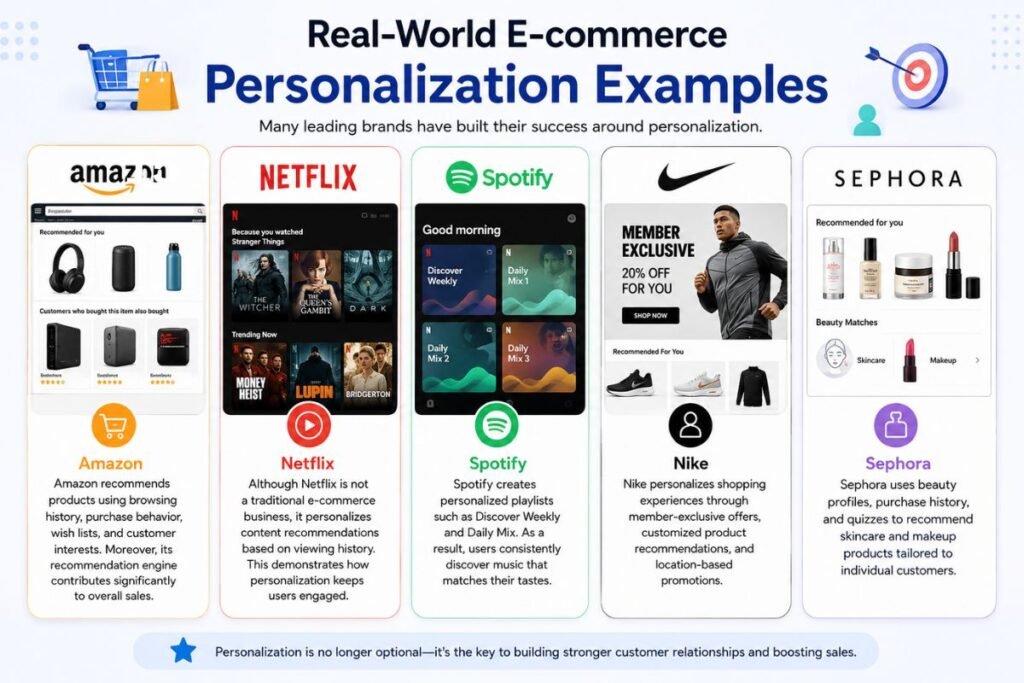
Many leading brands have built their success around personalization.
Amazon
Amazon recommends products using browsing history, purchase behavior, wish lists, and customer interests. Moreover, its recommendation engine contributes significantly to overall sales.
Netflix
Although Netflix is not a traditional e-commerce business, it personalizes content recommendations based on viewing history. This demonstrates how personalization keeps users engaged.
Spotify
Spotify creates personalized playlists such as Discover Weekly and Daily Mix. As a result, users consistently discover music that matches their tastes.
Nike
Nike personalizes shopping experiences through member-exclusive offers, customized product recommendations, and location-based promotions.
Sephora
Sephora uses beauty profiles, purchase history, and quizzes to recommend skincare and makeup products tailored to individual customers.
Benefits of E-commerce Personalization
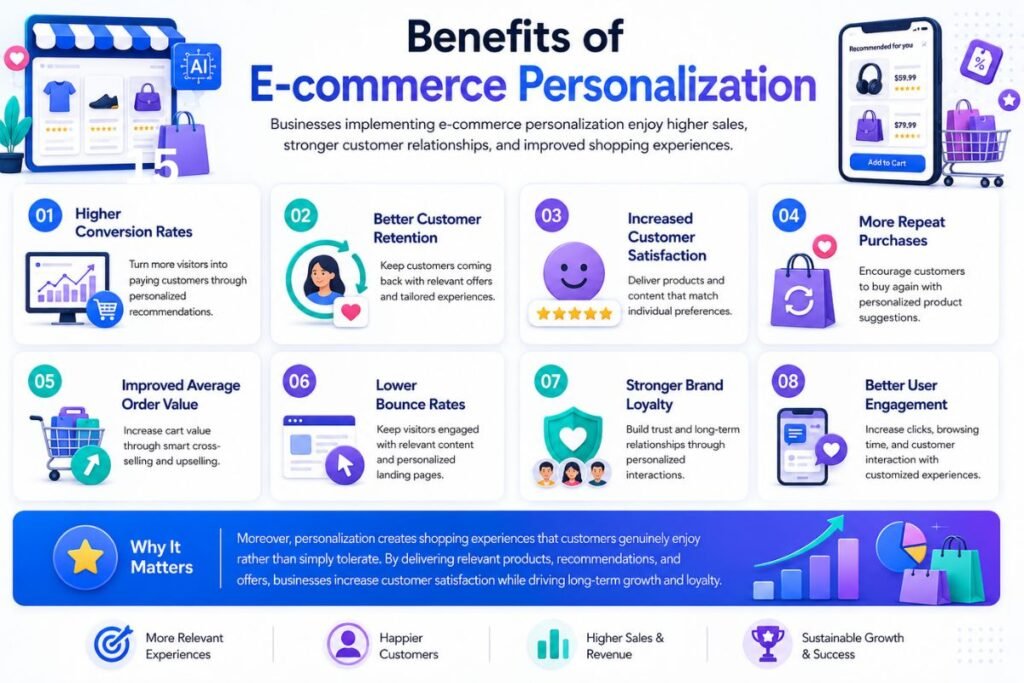
Businesses implementing E-commerce personalization often experience:
- Higher conversion rates
- Better customer retention
- Increased customer satisfaction
- More repeat purchases
- Improved average order value
- Lower bounce rates
- Stronger brand loyalty
- Better user engagement
Moreover, personalization creates shopping experiences that customers genuinely enjoy rather than simply tolerate.
Best Practices for Successful E-commerce Personalization
To maximize results, keep these best practices in mind:
Collect Relevant Customer Data
Use browsing behavior, purchase history, demographics, and preferences responsibly while respecting privacy regulations.
Use AI and Automation
Automation helps deliver personalized experiences at scale without requiring constant manual effort.
Test and Optimize
Run A/B tests regularly to identify which recommendations, emails, and offers perform best.
Respect Customer Privacy
Be transparent about data collection and provide users with clear privacy controls. Trust is essential for long-term success.
Keep Personalization Helpful
Personalization should simplify the shopping experience, not overwhelm customers with excessive recommendations.
Common Mistakes to Avoid
Many businesses struggle because they:
- Recommend irrelevant products
- Overuse customer data
- Ignore privacy regulations
- Send too many emails
- Personalize without enough data
- Fail to update recommendations
However, avoiding these mistakes helps create a more positive customer experience.
Future Trends in E-commerce Personalization
The future of personalization will become even more intelligent.
Emerging trends include:
- AI-driven shopping assistants
- Voice commerce personalization
- Predictive product recommendations
- Hyper-personalized marketing
- Augmented Reality shopping
- Real-time customer segmentation
As technology continues to evolve, businesses that embrace these innovations will remain competitive.
Conclusion
Today’s online shoppers expect experiences tailored to their needs, preferences, and behavior. E-commerce personalization is no longer just a competitive advantage—it has become a fundamental expectation.
By implementing the E-commerce personalization discussed in this guide, businesses can create more engaging shopping journeys, strengthen customer relationships, and drive sustainable growth. Start with a few simple strategies, measure the results, and refine your approach over time. Ultimately, thoughtful personalization benefits both customers and businesses, creating experiences that feel relevant, valuable, and memorable.
Frequently Asked Questions
01. What is E-commerce personalization?
Ans: E-commerce personalization is the process of customizing an online shopping experience based on customer data, browsing behavior, purchase history, preferences, and demographics. It helps businesses show relevant products, offers, and content to each visitor, making shopping more engaging and increasing the chances of a purchase.
02. Why is E-commerce personalization important?
Ans: E-commerce personalization improves customer satisfaction by delivering relevant shopping experiences. It also increases conversion rates, boosts average order value, reduces cart abandonment, and encourages repeat purchases. As a result, businesses build stronger customer relationships and achieve long-term growth.
03. What are the best E-commerce personalization examples?
Ans: Some of the most effective examples include personalized product recommendations, dynamic homepage content, personalized email campaigns, AI-powered product suggestions, cart abandonment emails, personalized discounts, loyalty program personalization, smart cross-selling, intelligent upselling, and customized checkout experiences.
04. How does AI improve E-commerce personalization?
Ans: Artificial Intelligence analyzes customer behavior, browsing history, and purchase patterns in real time. It predicts customer preferences and delivers accurate product recommendations, personalized offers, and relevant content. Therefore, AI helps businesses create smarter and more personalized shopping experiences.
05. What data is used for E-commerce personalization?
Ans: Businesses typically use browsing history, purchase history, customer demographics, location, device type, search behavior, wishlist activity, and customer preferences. However, this data should always be collected responsibly while respecting user privacy and data protection regulations.
06. Can small businesses benefit from E-commerce personalization?
Ans: Yes. Small businesses can use affordable personalization tools to recommend products, send personalized emails, offer customer-specific discounts, and improve the shopping experience. Even simple personalization strategies can increase customer engagement and sales without requiring a large budget.
07. What are the benefits of personalized product recommendations?
Ans: Personalized product recommendations help customers discover products they are more likely to purchase. This improves the shopping experience, increases conversion rates, raises average order value, and encourages repeat purchases by making product discovery easier and more relevant.
08. How can businesses avoid common personalization mistakes?
Ans: Businesses should avoid overusing customer data, sending excessive promotional emails, showing irrelevant recommendations, and ignoring privacy regulations. Instead, they should focus on providing valuable, relevant, and respectful personalized experiences that genuinely help customers.
09. Does E-commerce personalization increase sales?
Ans: Yes. Effective E-commerce personalization often leads to higher conversion rates, increased average order value, better customer retention, and improved customer loyalty. When shoppers receive relevant recommendations and personalized offers, they are more likely to complete purchases and return in the future.
10. What is the future of E-commerce personalization?
Ans: The future of E-commerce personalization includes AI-driven shopping assistants, predictive analytics, voice commerce, hyper-personalized marketing, augmented reality shopping, and real-time customer segmentation. As technology evolves, personalized shopping experiences will become even more accurate, interactive, and customer-focused.



4 Comments