
 -by
-by Artificial Intelligence (AI) is transforming the ecommerce industry faster than ever before. From personalized shopping experiences to automated customer support, AI E-Commerce helps online businesses improve efficiency, increase sales, and deliver better customer experiences.
Today, both small online stores and global ecommerce brands use AI-powered tools to understand customer behavior, optimize marketing campaigns, manage inventory, and streamline operations. As competition continues to grow in the digital marketplace, businesses that leverage AI gain a significant advantage.
In this guide, you’ll learn how to use AI in e-commerce, its benefits, practical applications, and the best strategies to help your online store grow.
What Is AI in Ecommerce?
AI e-commerce refers to the use of artificial intelligence technologies to automate processes, analyze data, improve customer experiences, and support business decision-making.
AI systems can:
- Analyze customer behavior
- Recommend products
- Predict future sales
- Automate customer service
- Improve marketing performance
- Optimize inventory management
- Detect fraud
By using AI effectively, ecommerce businesses can save time, reduce costs, and increase revenue.
Why AI Is Important for Ecommerce
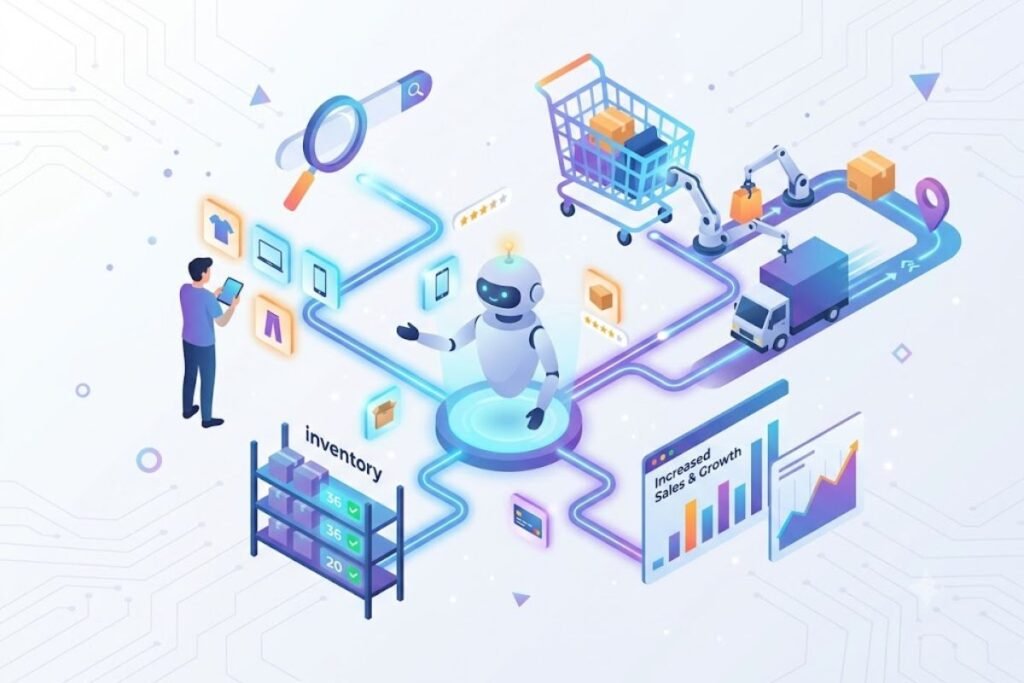
Online shoppers expect personalized and convenient experiences. AI helps businesses meet these expectations while improving operational efficiency.
Key Benefits of AI in Ecommerce
- Better customer experiences
- Increased conversion rates
- Improved customer retention
- Faster customer support
- Smarter inventory management
- More accurate demand forecasting
- Enhanced marketing performance
- Reduced operational costs
Businesses that adopt AI can often respond more quickly to customer needs and market changes.
Use AI for Product Recommendations
Product recommendation engines are one of the most popular uses of AI in e-commerce.
AI analyzes:
- Browsing history
- Purchase history
- Customer preferences
- Product interactions
It then suggests products that customers are most likely to buy.
Benefits
- Higher average order value
- Increased cross-selling opportunities
- Improved customer satisfaction
- Better shopping experiences
You can learn more in our ecommerce personalization guide.
Implement AI-Powered Chatbots
Customer support is critical for online stores. AI chatbots can provide instant responses to customer questions 24/7.
Common Chatbot Functions
- Answer product questions
- Track orders
- Process returns
- Recommend products
- Resolve basic customer issues
AI chatbots reduce support workloads while improving customer satisfaction.
Popular solutions include OpenAI API documentation and Google Cloud AI services.
Improve Search Functionality with AI
Many customers leave online stores because they cannot find what they need. AI-powered search helps users discover products faster by understanding:
- Natural language queries
- Misspellings
- User intent
- Product relevance
Example
Instead of searching for an exact product name, customers can type: “comfortable running shoes for beginners”. AI search systems understand the request and display relevant products.
Read our website search optimization guide for additional strategies.
Use AI for Personalized Marketing
Personalization is one of the biggest advantages of AI e-commerce. AI can create customized experiences based on customer behavior.
Personalized Marketing Examples
- Product recommendations
- Email campaigns
- Website content
- Promotions
- Dynamic pricing offers
Personalized experiences often result in higher engagement and better conversion rates.
Explore Google Analytics to better understand customer behavior data.
Automate Ecommerce Content Creation
Creating content for hundreds or thousands of products can be time-consuming. AI tools can help generate:
- Product descriptions
- Meta titles
- Meta descriptions
- Blog outlines
- Email copy
- Social media captions
While human review remains important, AI significantly speeds up content production.
Check our AI content marketing guide for best practices.
Optimize Inventory Management
Inventory management is a major challenge for ecommerce businesses. AI can analyze historical sales data and predict future demand.
AI Helps Businesses
- Avoid stock shortages
- Reduce overstocking
- Improve warehouse efficiency
- Forecast seasonal demand
Accurate inventory planning improves profitability and customer satisfaction.
Use AI for Dynamic Pricing
Dynamic pricing allows businesses to adjust product prices automatically based on market conditions.
AI analyzes:
- Competitor pricing
- Customer demand
- Inventory levels
- Seasonal trends
This helps businesses remain competitive while maximizing profit margins.
Learn more in our ecommerce pricing strategy guide.
Improve Customer Segmentation

Not all customers have the same interests or purchasing habits. AI can automatically group customers based on:
- Demographics
- Purchase behavior
- Shopping frequency
- Product preferences
Benefits
- Better targeting
- More effective advertising
- Higher conversion rates
- Improved customer loyalty
Customer segmentation helps marketers deliver more relevant campaigns.
Detect Fraud and Improve Security
Online fraud is a growing concern for ecommerce businesses. AI can identify suspicious activities in real time.
Fraud Detection Examples
- Unusual transaction patterns
- Suspicious login attempts
- Payment anomalies
- Fake account creation
AI-powered fraud prevention reduces financial losses and protects customer information.
You can explore PCI Security Standards for e-commerce security guidelines.
Enhance Customer Retention
Acquiring new customers often costs more than retaining existing ones. AI helps businesses identify customers who may stop purchasing.
AI Retention Strategies
- Personalized offers
- Loyalty rewards
- Re-engagement emails
- Product recommendations
These strategies encourage repeat purchases and improve customer lifetime value.
Use AI for Predictive Analytics
Predictive analytics helps businesses anticipate future trends. AI analyzes large datasets to identify patterns and opportunities.
Predictive Insights Include
- Future sales forecasts
- Product demand predictions
- Customer behavior trends
- Marketing performance estimates
Businesses can make smarter decisions based on data rather than assumptions.
Improve Ecommerce SEO with AI
Search engine optimization remains essential for ecommerce growth. AI tools can assist with:
- Keyword research
- Content optimization
- Technical SEO audits
- Internal linking suggestions
- Search trend analysis
AI does not replace SEO expertise but can improve efficiency and productivity.
Read our complete ecommerce SEO checklist to learn more.
Best AI Tools for Ecommerce

Several AI-powered tools help ecommerce businesses improve operations and customer experiences.
Popular options include:
- ChatGPT
- Jasper AI
- Shopify Magic
- Klaviyo AI
- Google Analytics
- Adobe Commerce AI
- Salesforce Einstein
- HubSpot AI
Before choosing a solution, evaluate your business goals and budget.
Challenges of Using AI in Ecommerce
Although AI offers many benefits, businesses should understand potential challenges.
Common Challenges
- Data privacy concerns
- Initial implementation costs
- Staff training requirements
- Dependence on data quality
- Ongoing optimization needs
Successful AI adoption requires planning, monitoring, and continuous improvement.
Future of AI in Ecommerce
The role of AI in ecommerce will continue expanding.
Future developments may include:
- More advanced personalization
- AI shopping assistants
- Voice commerce improvements
- Augmented reality integration
- Predictive customer service
- Automated supply chain management
Businesses that embrace AI today will be better prepared for tomorrow’s digital marketplace.
FAQs
Q: How is AI used in ecommerce?
Ans: AI is used for product recommendations, chatbots, customer support, marketing automation, inventory management, fraud detection, and personalized shopping experiences.
Q: Can small ecommerce businesses use AI?
Ans: Yes. Many affordable AI tools are available for small and medium-sized businesses.
Q: Does AI increase ecommerce sales?
Ans: AI can improve customer experiences, personalization, and marketing effectiveness, which often leads to higher conversion rates and increased sales.
Q: What is the best AI tool for ecommerce?
Ans: The best tool depends on your goals. Popular options include ChatGPT, Shopify Magic, Klaviyo AI, HubSpot AI, and Salesforce Einstein.
Final Thoughts
Artificial intelligence is no longer a futuristic concept in ecommerce. It is a practical business tool that helps online stores improve efficiency, personalize customer experiences, and increase revenue.
Whether you run a small online shop or a large ecommerce operation, AI can support everything from product recommendations and customer service to marketing automation and inventory management.
The most successful ecommerce businesses use AI strategically, combining automation with human expertise to create better experiences for customers and stronger results for their brands.





4 Comments